How Neural Networks are Learning Hand Lettering
Exploring the intersection of deep learning and the fluid art of calligraphy.
Introduction: What is a GAN?
At the heart of the digital calligraphy revolution lies the Generative Adversarial Network (GAN). Think of a GAN as a master calligrapher and a discerning critic working in a constant loop. The "Generator" attempts to create a stroke that mimics human ink flow, while the "Discriminator" tries to tell if the stroke was made by a machine or a human. Through millions of iterations, the Generator learns to create lettering so authentic it can fool even the most expert eye.
"The goal isn't just to copy shapes, but to simulate the biological rhythm of the hand."- ScriptMind AI Engineering Team
Dataset Creation from Vector Paths
Unlike standard image AI, calligraphy models require understanding the chronology of a stroke. We transform thousands of hand-drawn Spencerian and Copperplate samples into mathematical vector paths. These paths capture X and Y coordinates, but more importantly, they capture the velocity of the pen. By training on vectors rather than static pixels, our neural networks learn the 'soul' of the letterform—where it starts, where it pauses, and where it flourishes.
Understanding Weight, Pressure, and Flow
Our algorithms utilize Recurrent Neural Networks (RNNs) to predict the thickness of a line based on its direction. In Spencerian script, the pressure is rhythmic. We feed our models parameters including:
Nib Flex
Simulating the tines of a metal nib spreading under varying pressure.
Ink Viscosity
Calculating how ink pools at the end of a slow stroke or thins during a rapid flourish.
Paper Friction
Modeling the microscopic drag of the pen tip across different vellum textures.
Case Study: The Spencerian v2.0 Model
Our latest achievement involved training a model on over 10,000 pages of 19th-century business correspondence. The result is an AI that doesn't just write; it composes. It understands the spacing between words (kerning) and the vertical harmony between lines (leading) in a way that feels organic.
The Future: Synthetic Typography
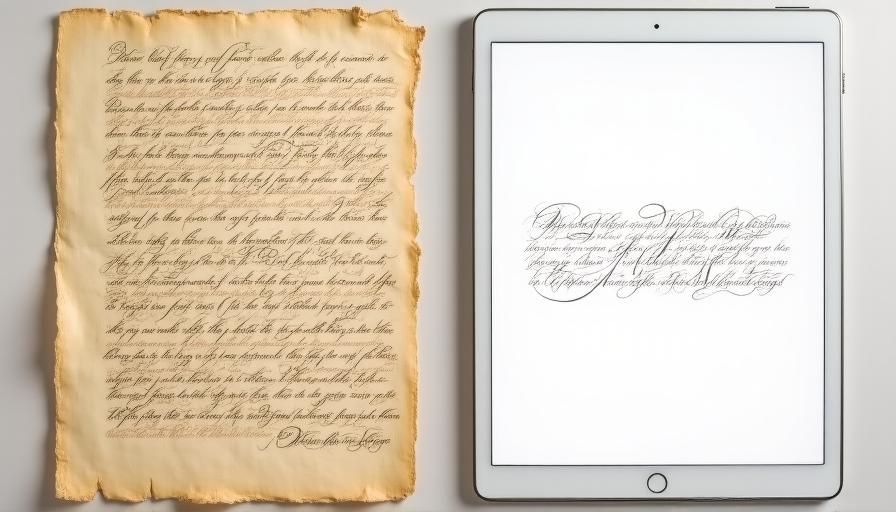
As we move forward, the line between machine-made and hand-crafted will continue to blur. ScriptMind AI is committed to using these neural networks not to replace the human calligrapher, but to provide them with new tools—generative brushes that respond to intent and automated assistants that help master the basics of form and flow.